
The Big Shift: Affiliate Is No Longer Just a “Conversion Channel”
For years, affiliate marketing was boxed into one narrow perception: discount codes, cashback sites, and last-click conversions. Useful? Yes. Strategic? Rarely.
That view is outdated.
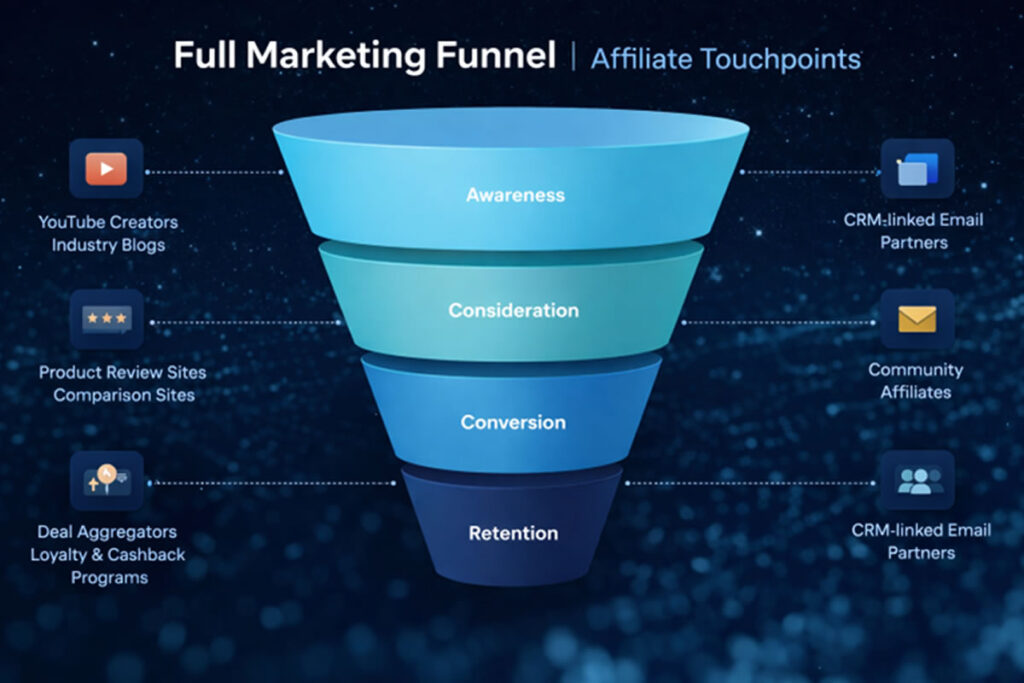
In 2026, affiliate marketing has evolved into a sophisticated partnership ecosystem that influences discovery, shapes consideration, drives conversion, and supports retention. The brands scaling sustainably today are not treating affiliate as a tactical afterthought — they’re integrating it into their full growth architecture.
Why now? Three reasons:
- Customer journeys are fragmented across platforms.
- Privacy shifts have reduced deterministic targeting.
- The creator economy has matured into a measurable performance channel.
Affiliate is uniquely positioned at the intersection of performance accountability and partner-led influence. When structured correctly, it becomes a scalable, pay-for-outcome growth engine — not just a coupon lever.
Key Takeaways
- Affiliate marketing in 2026 spans the entire funnel — not just last-click conversions.
- Creators, comparison platforms, loyalty programs, and content partners drive measurable influence earlier in the journey.
- Modern attribution and partnership platforms enable more accurate value distribution.
- Brands that operationalize affiliate strategically unlock incremental, scalable growth.
1. Quick Context: How Affiliate Marketing Evolved
Affiliate marketing began as a performance model built around direct-response mechanics: a tracked link, a commission, and a completed sale.
For years, it was optimized for last-touch attribution — whichever partner closed the deal received the payout. That structure naturally incentivized coupon sites and cashback platforms that captured users at the final step.
But the market shifted.
Today’s buyers:
- Research across multiple devices
- Discover brands through creators and content platforms
- Compare options via review sites
- Engage through email, communities, and loyalty ecosystems
Affiliate infrastructure has evolved alongside this behavior. Modern partnership platforms now allow:
- Multi-touch attribution
- Tiered commissions
- Lifecycle-based rewards
- Cross-channel data integrations
Affiliate is no longer about “who closed.” It’s about who influenced — and how much.
2. The Full-Funnel Case for Affiliate in 2026
Let’s break down how affiliate now operates across the entire funnel.
Awareness: Where Discovery Happens
Affiliate is increasingly embedded in content ecosystems:
- YouTube creators reviewing new products
- Substack writers recommending tools
- Podcast hosts sharing trackable links
- Industry blogs publishing thought leadership
These touchpoints introduce brands to high-intent audiences in trusted environments.
Unlike traditional display advertising, affiliate-based awareness often operates on performance-linked economics, reducing upfront media risk.
“Our top-performing creators don’t just convert. They introduce us to customers we wouldn’t reach through paid search.”
— Head of Growth
Consideration: Influencing Decision-Making
In the mid-funnel stage, affiliate plays a crucial comparison role:
- Product review sites
- Category-specific comparison platforms
- Influencer deep-dives
- Email newsletters focused on curated recommendations
These partners help users evaluate options and reduce uncertainty.
For enterprise and mid-market brands, this layer is particularly important in high-consideration verticals such as fintech, SaaS, travel, health, and D2C.
Conversion: Structured Performance at Scale
Conversion remains a strength — but it’s no longer the only objective.
Key conversion-focused affiliate partners include:
- Cashback and loyalty platforms
- Deal aggregators
- Retargeting affiliates
- Influencers with exclusive codes
The difference in 2026? Sophisticated brands structure payouts differently based on lifecycle value, customer type, and incremental contribution.
Retention: The Underestimated Lever
Retention is where affiliate is becoming especially powerful.
Examples:
- Loyalty programs incentivizing repeat purchases
- Subscription review sites promoting upgrades
- Community creators driving re-engagement
- CRM-linked partner campaigns
Affiliate can now be integrated into retention flows, particularly when connected to CRM and first-party data systems.
“Affiliate stopped being a closing tactic once we tied it into our CRM and lifecycle campaigns.”
— Affiliate Manager
3. Key Drivers Shaping Affiliate in 2026
Here are five industry forces accelerating affiliate’s transformation:
1. Data Integration & Attribution Advances
Improved tracking frameworks and hybrid attribution models allow brands to measure influence beyond last-click.
Implication: Growth teams must invest in unified reporting to understand partner impact across stages.
2. Creator Economy Maturation
Creators now operate like media businesses, with structured audiences and predictable conversion capacity.
Implication: Affiliate should be integrated into influencer strategies, not separated from them.
3. Privacy-Driven Targeting Shifts
With tighter privacy regulations and signal loss from third-party cookies, performance channels tied to contextual and partnership models are gaining relevance.
Implication: Affiliate offers scalable performance without relying solely on invasive targeting mechanisms.
4. Channel Diversification Pressure
Rising paid media costs are forcing brands to diversify acquisition sources.
Implication: Affiliate provides a risk-adjusted channel where payouts are tied to outcomes.
5. Rise of Partnership Commerce Platforms
Modern platforms allow partner segmentation, tiered payouts, automated approvals, and performance transparency.
Implication: Affiliate is now operationally scalable at enterprise levels.
4. Operational Playbook: Scaling Affiliate as a Full-Funnel Channel
Here’s a practical framework for marketing leaders.
1. Set Cross-Channel KPIs
Align affiliate metrics with broader marketing goals.
Recommended Metrics:
- Assisted conversions
- Incremental revenue
- Customer acquisition cost (blended)
- Lifetime value (LTV)
Pitfall: Measuring affiliate only on last-click ROAS.
2. Invest in Partner Discovery & Onboarding
Actively recruit creators, content platforms, and niche communities.
Recommended Metrics:
- Partner activation rate
- Revenue per partner
- Time to first conversion
Pitfall: Over-relying on passive network signups.
3. Align Creative Assets Across Funnel Stages
Provide partners with differentiated messaging:
- Awareness: educational content
- Consideration: comparison guides
- Conversion: offers & urgency triggers
Recommended Metrics:
- Click-through rate
- Engagement rate
- Conversion rate by content type
Pitfall: Giving every partner the same generic creative kit.
4. Use Incrementality Testing
Run controlled experiments to determine true lift.
Recommended Metrics:
- Incremental revenue
- Conversion lift vs. control group
Pitfall: Paying for conversions that would have happened organically.
5. Integrate Affiliate into CRM & Retention
Sync affiliate data with lifecycle marketing platforms.
Recommended Metrics:
- Repeat purchase rate
- Subscription upgrades
- Churn reduction
Pitfall: Treating affiliate as acquisition-only.
6. Structure Tiered Incentives
Reward partners differently based on customer value or funnel contribution.
Recommended Metrics:
- New vs. returning customer mix
- Average order value
- LTV per partner segment
Pitfall: Flat commissions that fail to encourage high-value behavior.
“The breakthrough came when we stopped paying everyone the same and started rewarding incremental impact.”
— VP Marketing
5. Measurement and Governance: Building a Sustainable Program
As affiliate scales, governance becomes critical.
Attribution Approach
A pragmatic framework includes:
- Multi-touch attribution modeling
- Incrementality testing for high-volume partners
- Unified commission rules aligned to lifecycle value
Avoid overly complex models that create internal confusion. The goal is directional accuracy, not theoretical perfection.
Governance Best Practices
- Clear brand guidelines for partners
- Automated compliance monitoring
- Fraud detection systems
- Transparent approval workflows
- Regular partner audits
Enterprise brands must also ensure legal alignment in international markets.
Strong governance builds trust — both internally and with partners.
6. When to Partner with a Specialist
Not every brand needs external support. But certain scenarios justify it:
- Entering new verticals or international markets
- Launching large-scale creator networks
- Scaling from pilot to enterprise-level program
- Navigating complex attribution models
- Rebuilding an underperforming affiliate channel
A specialist agency typically provides:
- Partner recruitment frameworks
- Attribution design
- Compliance monitoring
- Campaign optimization
- Cross-channel integration strategy
The right partnership should feel like an extension of your growth team — not a transactional vendor relationship.
7. Final Recommendations: Your 90-Day Action Plan
If you’re evaluating affiliate as a scalable growth channel, here’s where to begin:
- Audit your current affiliate attribution model and identify leakage from last-click bias.
- Recruit 10–20 mid-funnel partners (content creators, niche publishers, comparison sites) and test structured incentives.
- Run one incrementality test on a high-volume partner to measure true lift.
These three steps alone can reposition affiliate from a passive revenue stream to a structured growth engine.
Affiliate marketing in 2026 is not about discounts or opportunistic conversions. It’s about building a diversified, performance-driven partnership ecosystem that supports every stage of the customer journey.
If your growth strategy needs a scalable, accountable channel beyond paid media volatility, affiliate deserves a serious seat at the table. Connect with Aston Media to explore how a structured, full-funnel affiliate program can unlock sustainable performance growth for your brand.